“The good which true reason approves is solid and everlasting.” — Seneca, Letter 66
At our most recent Brisbane Stoics meeting, around twenty participants gathered to explore one of the central ideas of Stoic philosophy: virtue.
Before opening Seneca’s letter, we began with a simple question:
What is virtue?
The discussion that followed was lively and thoughtful. Members offered a range of perspectives, drawing on everyday understandings of virtue as moral goodness, integrity, courage, kindness, and strength of character. As the conversation unfolded, a common theme began to emerge. Virtue seemed to involve the excellence of a thing according to its nature.
A good knife cuts well. A good horse runs well. A good musician plays well.
What then would make a human being good?
This line of discussion brought us surprisingly close to the traditional Stoic position before we had even opened the text. For the Stoics, virtue is the excellence of our specifically human capacities—our ability to reason, exercise judgement, act justly, and participate wisely in the world around us.
With this foundation established, we turned to Seneca’s Letter 66, On Various Aspects of Virtue.
What followed was a fascinating encounter with one of Stoicism’s most challenging ideas.
Can All Virtues Really Be Equal?
Seneca asks a question that initially seems strange.
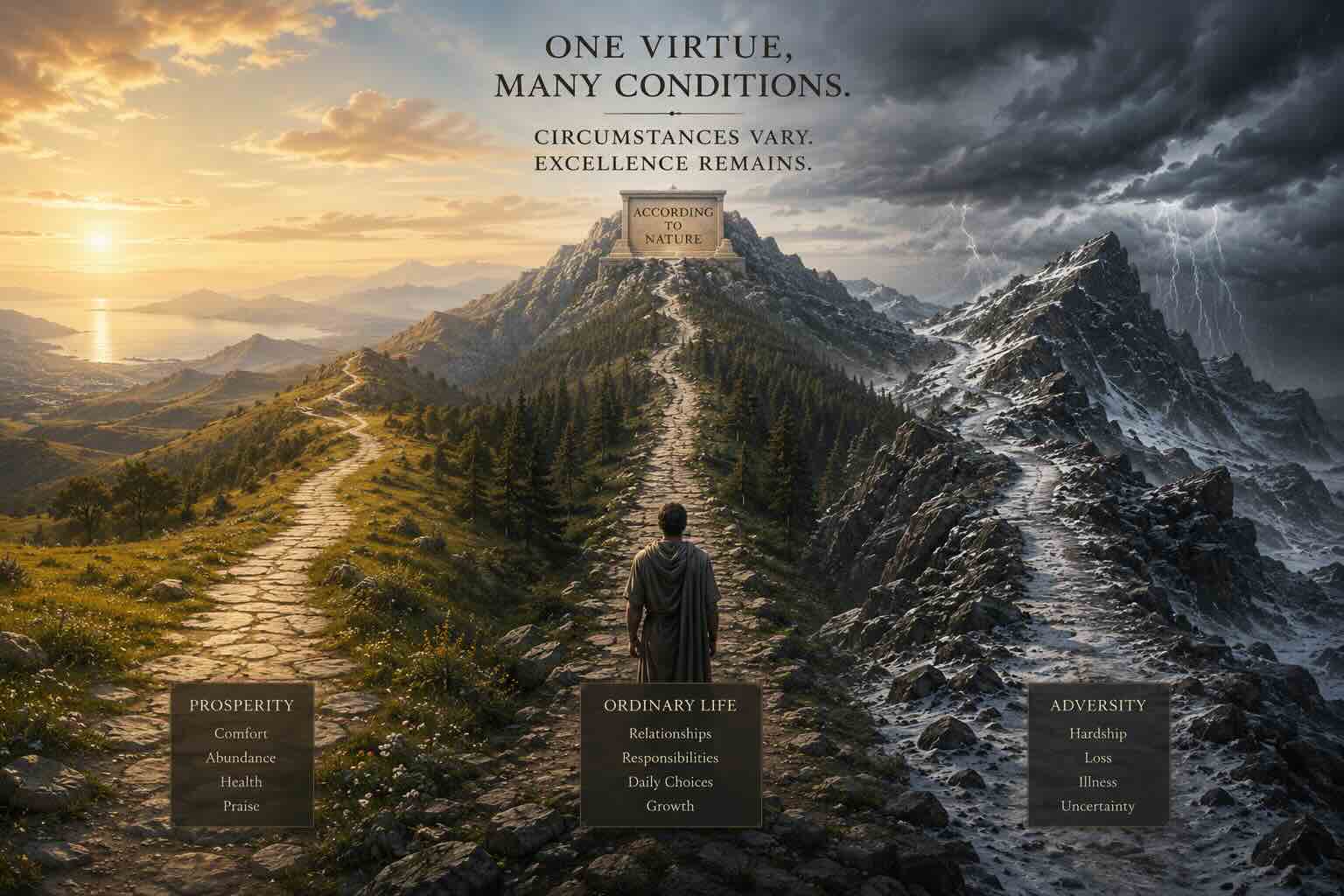
Is the person who remains calm and grateful during a pleasant season of life displaying a greater good than the person who faces illness, hardship, or suffering with courage and dignity?
Most of us instinctively think there must be a difference.
Surely joy is better than pain.
Surely health is better than sickness.
Surely prosperity is better than adversity.
Seneca agrees—up to a point.
Health is naturally preferable to illness. Comfort is naturally preferable to hardship. We should generally seek what is in accordance with nature and avoid what is contrary to it.
Yet Seneca insists that when we examine the virtue displayed in each situation, something remarkable appears.
The courage shown in adversity is not a lesser virtue because it arose amidst difficulty. Likewise, wisdom exercised in prosperity is not made greater because fortune happened to smile upon it.
The circumstances differ.
The virtue does not.
For Seneca, virtue is not measured by the material it works upon, but by the excellence with which it responds.
This idea challenged many of our ordinary assumptions about success, happiness, and flourishing.
The Independence of Character
One of the most powerful sections of the letter concerns Seneca’s friend Claranus.
Claranus possessed a frail and physically unimpressive body, yet Seneca describes him as genuinely beautiful because of the quality of his character.
The soul, Seneca argues, beautifies the body rather than the body beautifying the soul.
This inversion of ordinary values runs throughout the letter.
We are often tempted to evaluate ourselves according to external circumstances:
- How successful am I?
- How healthy am I?
- How wealthy am I?
- How respected am I?
The Stoics continually redirect our attention elsewhere.
The question is not what happens to us.
The question is how we meet what happens.
Virtue remains available under all conditions because it belongs to the quality of our participation rather than the circumstances in which we participate.
Reading the Stoics Themselves
A recurring theme throughout the evening was the value of returning to the original Stoic sources.
Seneca’s writing is vivid, provocative, and often surprising. Reading the Stoics directly allows us to encounter the philosophy in its living form rather than only through summaries and interpretations.
While modern introductions are valuable, there is something distinctive about hearing the voices of Seneca, Epictetus, Marcus Aurelius, Musonius Rufus, and the other Stoics speak for themselves.
Over time, their language begins to shape the way we perceive the world.
Their concerns become our concerns.
Their questions become our questions.
One of my hopes for these readings is that they encourage members to explore the original texts and develop their own relationship with this rich philosophical tradition.
Practising Letter 66 This Month
A philosophy becomes meaningful only when it is lived.
Over the coming month, consider experimenting with the following reflection whenever you encounter something difficult or frustrating.
Pause and ask:
What would virtue look like here?
Not:
- How can I escape this?
- Why is this happening to me?
- When will this be over?
But:
What quality of character is being called for in this moment?
Perhaps the situation calls for courage.
Perhaps patience.
Perhaps justice.
Perhaps self-restraint.
Perhaps wisdom.
The Stoics remind us that while circumstances vary endlessly, the opportunity to develop excellence of character is always present.
In the language of Aretotherapy, we might say that every domain of life—work, family, friendship, community, health, loss, and success—offers an invitation to participate well. The question is not whether the domain is pleasant or unpleasant, but whether we can bring our best capacities into relationship with it.
Virtue is not something we possess once and for all.
It is something we practise.
Until Next Time
As always, the formal discussion continued informally over coffee afterwards, where conversations about Stoicism, philosophy, psychology, and life carried on long into the evening.
Thank you to everyone who attended and contributed.
We look forward to seeing you at our next Brisbane Stoics meeting.
Until then, may you remember Seneca’s challenge:
External circumstances may differ greatly, but excellence of character remains available in every situation.
Leave a Reply
You must be logged in to post a comment.