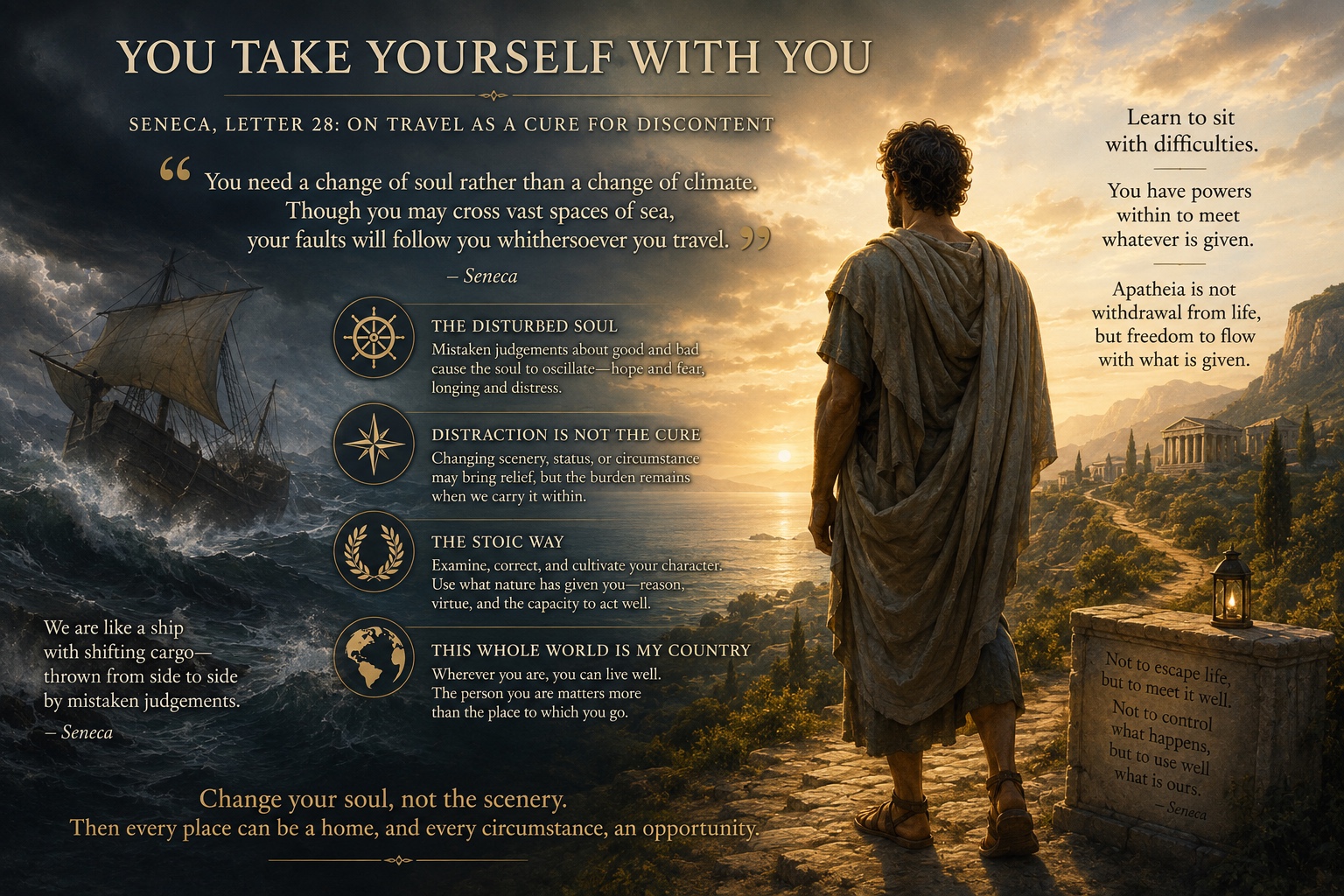
Seneca on Travel, Distraction, and Learning to Be at Home in the World
Around 30 people joined us at New Farm Library for our latest Brisbane Stoics meeting, where we gathered to read and discuss Seneca’s Letter 28, On Travel as a Cure for Discontent.
Seneca begins with an observation that remains remarkably familiar almost two thousand years later. His friend has travelled widely and changed his surroundings, yet finds that the heaviness of mind he hoped to escape has travelled with him.
Seneca’s response is characteristically direct:
“You need a change of soul rather than a change of climate.”
Our discussion began with members sharing their own thoughts and experiences of travel. Travel can certainly broaden our experience, expose us to different ways of living, create memories and provide genuine opportunities for reflection. But we asked whether travel itself necessarily cultivates an inner life—or whether it can sometimes become another way of avoiding one.
This led us to consider travel in Seneca’s letter as something larger than tourism. Travel becomes a particularly clear example of distraction: the hope that changing something outside ourselves will resolve a disturbance that has its source in the way we are living and thinking.
We can easily imagine the pattern.
We become unhappy or overwhelmed with life at home and long to get away. A holiday brings relief. For a time, our worries seem distant. Yet as the return approaches, the old anxiety begins to reappear.
The scenery has changed. We have not.
Seneca gives us a wonderful image for this instability. Cargo properly secured within a ship causes little difficulty, but cargo shifting violently from one side to another can cause the entire vessel to list.
The group explored how this image resembles the Stoic understanding of psychological disturbance. We can become pulled back and forth between unstable ideas about what will finally make us happy:
If only I could get away.
If only my circumstances changed.
If only I had this job, this relationship, this house, this experience.
We move toward one external thing, experience temporary relief, and then find ourselves pulled toward another.
The problem is not that travel, comfort, relationships or pleasant circumstances are bad. The problem begins when we ask them to provide something they cannot reliably provide: a stable foundation for a good life.
Seneca instead directs attention toward the development of the person who travels.
The Stoic project is therefore not to arrange the world so perfectly that nothing disturbs us. It is to cultivate the capacities by which we can make good use of whatever circumstances we encounter.
This gives another meaning to Seneca’s striking statement:
“The person you are matters more than the place to which you go.”
If the cultivation of character becomes central to life, then circumstances themselves can become opportunities for its exercise. Difficulty can call upon courage. Uncertainty can call upon judgement. Frustration can exercise patience. Other people can provide opportunities for justice, generosity and understanding.
From this perspective, we need not spend our lives searching for the perfect conditions in which to finally live well.
We begin where we are.
Perhaps this is also why Seneca can say:
“This whole world is my country.”
The person who develops the ability to meet life well becomes increasingly capable of being at home wherever they find themselves.
Importantly, Seneca does not suggest deliberately seeking hardship. He even warns against unnecessarily placing ourselves in unhealthy environments. The wise person may endure the storm when necessary, but does not need to go looking for storms.
There is a difference between welcoming life as an opportunity to develop and needlessly making life difficult.
Toward the end of the letter, Seneca turns the discussion inward once more. Borrowing a saying from Epicurus, he reminds us that recognising our own errors is the beginning of correcting them.
Before changing countries, jobs, relationships or circumstances, we might therefore first ask what part of the disturbance belongs to us.
Two Practices for the Month Ahead
When you feel the urge to escape, become curious about it.
Before immediately distracting yourself, changing circumstances or seeking relief, ask:
What am I hoping this change will remove from me?
And then the more difficult question:
Will I still carry it with me?
Sometimes changing circumstances really is wise. But the question helps us distinguish movement toward something worthwhile from movement that is simply flight.
Ask what this situation allows you to practise.
When something inconvenient or difficult occurs, experiment with changing the question from:
“How do I get out of this?”
to:
“What capacity can I exercise here?”
Perhaps patience. Courage. Humour. Self-restraint. Kindness. Practical wisdom.
The circumstance may not have been chosen, but how we meet it remains a field for practice.
Philosophy Among Friends
Some particularly personal and touching experiences were shared during the morning. These moments were a reminder that philosophy is often practised best not in isolation, but among people willing to think carefully and speak openly with one another.
We are very pleased that Brisbane Stoics continues to develop into such a supportive and thoughtful space—and it was encouraging to hear others express the same feeling during the meeting.
As usual, the formal discussion did not quite end when we left the library. Many of us continued the conversation afterwards over coffee at a nearby café.
A big thank you to everyone who attended, contributed ideas, asked questions, listened to others, and helped create the atmosphere of the morning.
Brisbane Stoics meets at 9:00am on the second Sunday of each month in the New Farm Library meeting room.
Newcomers are always welcome. You do not need any previous knowledge of Stoicism—only an interest in philosophy and a willingness to join the conversation.
We look forward to seeing you at the next one.
Leave a Reply
You must be logged in to post a comment.