October Meeting Reflection — 11 October 2026
Around 40 people joined us at New Farm Library for our October Brisbane Stoics meeting, making it one of our best-attended gatherings yet!
Our topic for the month was Stoic Logic, a subject that might not immediately sound as appealing as the more familiar Stoic themes of happiness, resilience or virtue.
Our host, Courtney Shipley, admitted that he had largely avoided studying Stoic logic himself, partly because of a longstanding assumption that it would be rather difficult and dry. As it turned out, the subject proved surprisingly interesting, generating plenty of questions, discussion and some entertaining philosophical puzzles.
The Ancient Stoics and Their Love of Puzzles
We began by exploring the historical development of Stoic logic and its relationship to the earlier Megarian school of philosophy.
One particularly interesting figure was Eubulides, famous for developing puzzles that continue to challenge philosophers today.
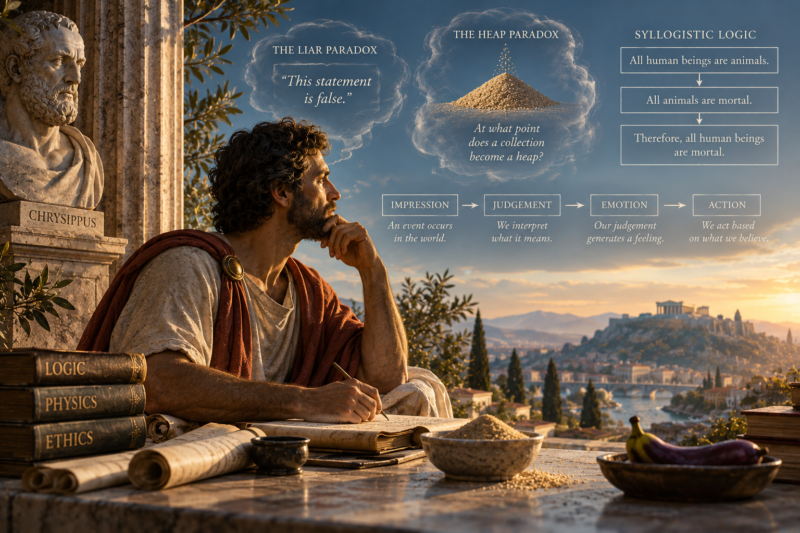
Consider the Liar Paradox:
“This statement is false.”
If the statement is true, then it must be false. But if it is false, then surely it must be true!
Or consider the Heap Paradox. One grain of sand is clearly not a heap. Adding another grain doesn’t seem to make it a heap either. But if we continue adding grains, at what precise point does a heap appear?
These puzzles provided an entertaining introduction to a serious philosophical problem: how do we distinguish truth from error, and how reliable are the concepts and judgements we use to understand the world?
The early Stoics took these questions very seriously. Chrysippus, one of the great thinkers of the Stoic school, developed a sophisticated system of propositional logic that anticipated important features of modern logic.
Unlike Aristotle’s approach, which largely examined relationships between categories or terms, Stoic logic explored how complete propositions could be combined to form valid arguments.
For example:
If it rains, the ground will become wet.
It is raining.
Therefore, the ground will become wet.
The structure of such arguments matters because it allows us to examine whether a conclusion genuinely follows from what we have accepted as true.
But what has any of this to do with living a good life?
Logic and the Stoic Understanding of the Mind
Perhaps the most interesting part of the morning came when we explored the relationship between logic and Stoic psychology.
The Stoics believed that our encounters with the world give rise to impressions. In human beings, these impressions can contain propositional content—something that can be examined, accepted, questioned or rejected by our rational faculty.
Imagine discovering that someone has scratched your car.
The initial impression might simply be:
Someone has scratched my car.
But we might quickly add something else:
How dare they! I’ve been wronged! This is terrible!
The Stoics recognised that much of our psychological disturbance arises not merely from what happens, but from the additional judgements we make about what happens.
We can begin treating something inconvenient as a catastrophe, or something merely preferred as essential to our happiness.
This is where logic becomes a practical discipline.
Can we distinguish what has actually happened from what we have added to it?
Can we recognise when our conclusions are unsupported, exaggerated or simply mistaken?
And can we learn to suspend judgement when we do not yet know enough?
For the Stoics, this ability was fundamental to the cultivation of wisdom and the development of good character.
Epictetus: Learning to Test Our Impressions
Our presentation concluded with a reading from Epictetus’ Discourses, Book 1, Chapter 7.
Epictetus compares the ability to reason correctly with the ability to recognise genuine and counterfeit coins.
It is not enough to tell someone to accept good coins and reject bad ones. They must develop the knowledge and skill necessary to tell the difference.
The same is true of our impressions.
Simply advising someone to think correctly is of little use unless they have cultivated the ability to recognise what is true, false or uncertain.
This requires practice.
Epictetus is particularly insistent that we should not treat our impressions carelessly. How we judge them influences how we feel, what we desire and, ultimately, how we act.
Yet the later Stoics also remind us that philosophy should never become merely an academic exercise. The purpose of studying logic is not simply to win arguments or demonstrate intellectual cleverness.
It is to become better at living.
Logic, physics and ethics were understood as interconnected parts of Stoic philosophy. Clear reasoning helps us understand our experiences, but we must also develop an understanding of Nature, our responsibilities to others, and what constitutes a genuinely good life.
Two Practices for the Month Ahead
1. Separate the impression from the judgement.
The next time you feel frustrated, offended or anxious, pause and ask yourself:
What do I actually know about this situation?
Then consider:
What have I added through my own interpretation?
You may discover that some of the disturbance comes from conclusions that are not necessarily supported by the facts.
2. Practise suspending judgement.
When you encounter something uncertain, experiment with allowing yourself to say:
I don’t know enough about this yet.
The Stoics recognised that wisdom sometimes requires withholding assent rather than rushing toward a conclusion.
You don’t need to have an immediate opinion about everything.
Sometimes the most rational response is simply to remain curious.
Philosophy Among Friends
Once again, our meeting demonstrated that even a seemingly technical philosophical subject can become an opportunity for lively and meaningful conversation.
It was particularly encouraging to see so many people contributing their own perspectives, asking questions and helping one another explore unfamiliar ideas.
With around 40 people attending, Brisbane Stoics continues to grow as a community of people interested not merely in learning about ancient philosophy, but in discovering how its ideas might enrich our lives today.
After the meeting, many members continued the discussion at our usual local café, where philosophical conversations have become as much a part of our gatherings as the presentations themselves.
A big thank you to everyone who attended and contributed to another enjoyable morning.
Join Us Next Month
Brisbane Stoics meets at 9:00am on the second Sunday of each month, at the New Farm Library meeting room.
Our next regular meeting is Sunday, 8 November 2026.
Whether you are new to Stoicism or have been studying philosophy for years, you are warmly welcome. No previous knowledge is necessary—just curiosity, an open mind and a willingness to join the conversation.
We look forward to seeing you there!
Leave a Reply
You must be logged in to post a comment.