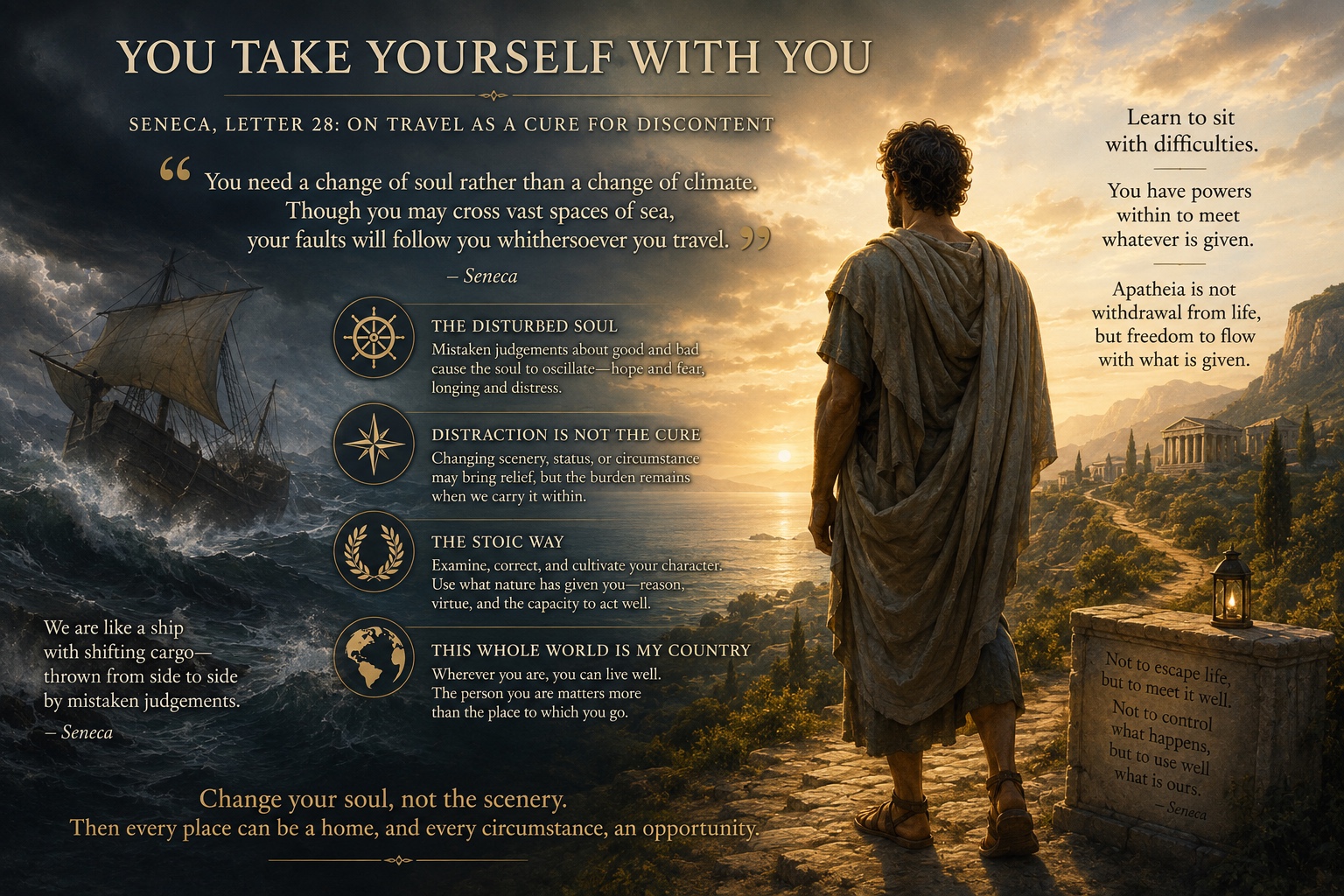
You Take Yourself With You
Seneca, the Oscillating Soul, and Learning to Meet What Is Given
At our latest Brisbane Stoics meeting, around 30 people gathered at New Farm Library to discuss Seneca’s Letter 28, On Travel as a Cure for Discontent.
Seneca begins with an observation that remains remarkably contemporary. His correspondent has travelled extensively, changed scenery and crossed great distances, yet finds that the heaviness of his mind remains.
Seneca tells him:
“You need a change of soul rather than a change of climate.”
He then recalls the wonderfully simple advice supposedly given by Socrates to another dissatisfied traveller: why are you surprised that travelling has not helped you, when you always take yourself with you?
Our discussion began with travel itself. Members reflected on ways in which travel genuinely can enrich a life: exposure to other cultures, encounters with different people, beautiful landscapes, unfamiliar experiences and the interruption of routines that sometimes allows us to see our lives differently.
But Seneca seems interested in a particular use of travel: travel as escape.
In this sense, travel becomes an example of something much broader. We might travel, consume, work, scroll, drink, pursue relationships, seek entertainment or continually rearrange our circumstances because we are trying to manage a disturbance within ourselves.
Seneca’s warning is that distraction may temporarily relieve distress without addressing its source.
The scenery changes.
The disturbance waits for us.
The Oscillating Soul
One of Seneca’s images in Letter 28 led our discussion deeper into Stoic psychology.
He compares the disturbed person to a ship carrying unsecured cargo. When the cargo remains properly situated, the ship can carry it. But when the load shifts violently from one side to another, the entire vessel begins to list.
This image is particularly interesting when considered alongside the early Stoic account of the passions associated with Chrysippus.
For the Stoics, the soul was not an immaterial Cartesian mind somehow separated from the body. It was corporeal: a living, tension-filled pneuma. Consequently, psychological disturbance could be described dynamically, in terms of movements within the soul.
Chrysippus described passion as an excessive and disobedient movement of the soul associated with mistaken judgement. From our first-person perspective, we experience these movements as fear, craving, distress, elation and the other passions.
We might think of the person Seneca describes as oscillating between competing judgements about the good.
I cannot bear being here.
If I could only get away, I would feel better.
The person travels and experiences relief.
This is what I needed.
Then the holiday nears its end.
Soon I have to go back.
The mind is pulled one way and then another because it has located its good in changing external circumstances. Home appears bad; elsewhere appears good. Escape promises salvation; return threatens distress.
Like Seneca’s unsecured cargo, the person is thrown from side to side.
The geographical movement is therefore accompanied by another movement—the oscillation of a soul that has not yet discovered something stable by which to orient itself.
Apatheia Is Not Apathy
This helps us understand the Stoic ideal of apatheia.
The English word “apathy” can make this sound like emotional numbness: a person becoming so detached that nothing affects them.
That is not the Stoic aspiration.
Apatheia is freedom from the disordered passions generated by mistaken judgements about good and evil. The aim is not to cease participating in life, but to become increasingly capable of meeting life without being wrenched backwards and forwards by every alteration of fortune.
We might describe it as developing the capacity to flow with what is given.
This does not mean passivity. The Stoic can prefer health to sickness, friendship to loneliness, security to danger and peace to conflict. Seneca explicitly says that the wise person need not deliberately seek storms merely to demonstrate an ability to endure them.
But when circumstances cannot be arranged according to our preferences, something remains available to us: our capacity to meet them well.
And this is where Letter 28 becomes more than an argument against using holidays as therapy.
What Are We Trying Not to Feel?
Seneca asks us to examine the impulse to flee.
When we immediately seek distraction from discomfort, we may never discover what the discomfort is asking of us.
There is an important difference between wisely changing a harmful situation and compulsively changing circumstances because we cannot tolerate what arises within us.
Seneca therefore offers something considerably more demanding than distress management.
Sit with the difficulty.
Examine it.
Discover what belongs to circumstance and what belongs to your judgement about circumstance.
Most importantly, remember that Nature has not left you entirely defenceless before what happens.
You possess capacities.
You can reason. You can reconsider an impression. You can exercise patience. You can restrain an impulse. You can ask for help. You can act courageously. You can treat another person justly even while distressed. You can discover that something which initially appeared unbearable can, in fact, be borne.
The Stoic gradually learns not merely that difficulties occur, but something about the kind of creature they are when difficulties occur.
This may explain Seneca’s striking confidence that, once the burden within has been addressed, even an inhospitable place can become a “hospitable abode.”
The person has ceased demanding that the world first become comfortable before they can begin living well.
“This Whole World Is My Country”
Seneca consequently shifts from travel as escape to an extraordinary cosmopolitan statement:
“I am not born for any one corner of the universe; this whole world is my country.”
There is something liberating about this.
If my ability to live well depends upon obtaining precisely the right surroundings, then much of my life must be spent attempting to control circumstances.
But if what matters most is the cultivation of the capacities through which circumstances are met, then the entire world becomes a possible field for their exercise.
Difficulty can call forth courage.
Uncertainty can exercise judgement.
Delay can exercise patience.
Success can exercise temperance.
Conflict can exercise justice.
Loss can ask us what remains.
The question gradually changes from “How can I make reality stop disturbing me?” to “How can I meet this well?”
Perhaps this is the deeper freedom toward which Stoic apatheia points.
Not an escape from the movement of life, but an increasing capacity to move with it.
The Person Matters More Than the Place
Toward the end of our discussion, some members shared touching personal experiences of confronting difficulties that could not simply be escaped. These contributions changed the character of the conversation. Stoicism ceased, for a moment, to be something contained in an ancient text and became something being examined against actual lives.
Seneca’s advice can sound severe when reduced to a slogan: you cannot escape yourself.
But Letter 28 contains a more hopeful message.
You do not need to escape yourself.
You can cultivate yourself.
You can become increasingly capable of carrying what life gives you without being continually thrown from one side of the ship to the other.
And perhaps, eventually, we discover what Seneca wanted his correspondent to understand:
The place matters less when the person has learned how to live.
The Brisbane Stoics meet at 9:00am on the second Sunday of each month at the New Farm Library meeting room. Our meetings involve a reading from Stoic philosophy followed by open discussion, reflection and—usually—continued conversation over coffee afterwards.
Newcomers are always welcome.
Leave a Reply
You must be logged in to post a comment.